
Living systematic reviews: what they are and how to run one
What a living systematic review is, when a review should go living, and a cycle log of what to record each cycle, mapped to PRISMA-LSR.
By George Burchell
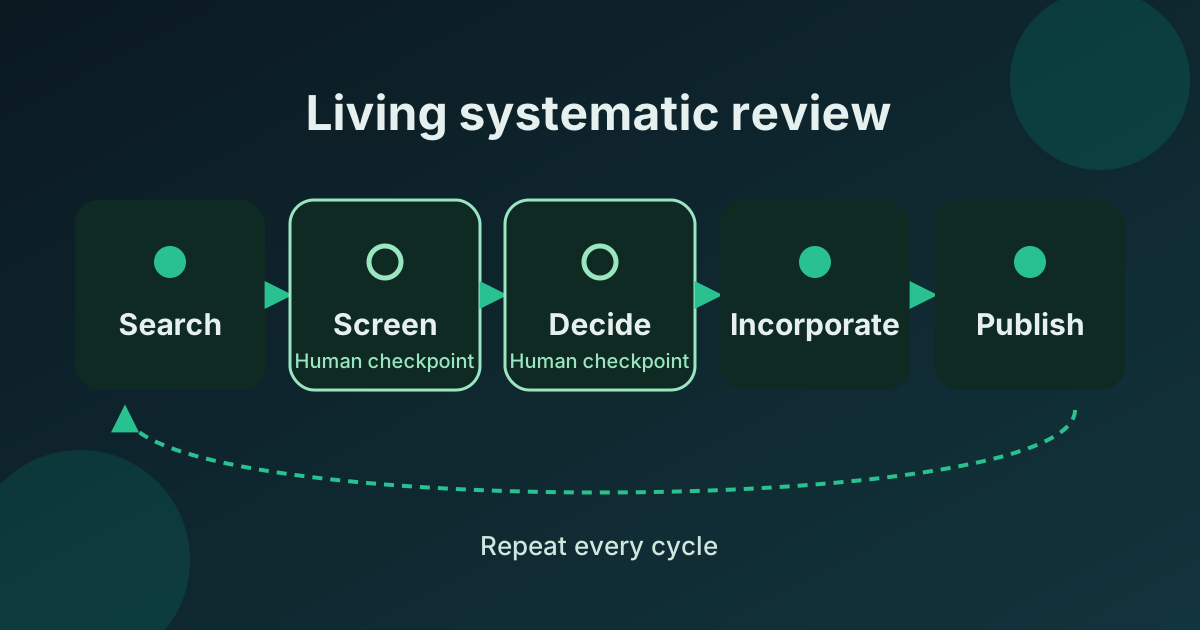
A living systematic review is "a systematic review that is continually updated, incorporating relevant new evidence as it becomes available" (Elliott et al. 2017, quoted in the Cochrane Handbook, chapter 21). It uses the same methods as a standard review, but you search, screen and incorporate new studies on a fixed cycle. The Handbook says searches should generally run at least every three months, and monthly updates are common.
This guide covers what changes when a review goes living, how to decide whether yours should, what one cycle looks like, and a cycle log you can copy so each version is easy to report.
What makes a review "living"
The Handbook is clear that a living review is not a different review method. It follows the same core steps as a standard systematic review. What changes is how often new evidence is sought, screened and incorporated, and the fact that methods and inclusion criteria may change over time.
The idea was first proposed in 2014. Cochrane piloted it between 2015 and 2018, and production rose sharply during the COVID-19 pandemic. The Handbook also reports the hard part: evaluations have found that a substantial share of living reviews had no updates, or late ones, after the first version. The reasons given include lost funding, waning commitment and the burden of screening search results. Planning matters more than enthusiasm.
| Standard review | Updated review | Living review | |
|---|---|---|---|
| Searching | One search window | A new search when the team decides to update | Repeated on a planned cycle, at least every three months |
| New evidence | Included once, at publication | Added in one batch at the update | Screened every cycle; incorporated when it is likely to change conclusions or certainty |
| Protocol | Fixed before the review | Revised for the update | A living document; changes are logged in a table before each update |
| Reporting | PRISMA 2020 | PRISMA 2020 | PRISMA 2020 plus the PRISMA-LSR extension, with a status between versions |
| Ending | Published once | May be updated again later | Retired with a planned final update and a note to readers |
The living column follows chapter 21 and PRISMA-LSR. The other two columns are the usual practice it is contrasted with.
Should your review be living?
The Handbook gives four criteria. Three come from Garner et al. 2016 and one is about feasibility. All four should be met before a living review goes ahead. If any one is missing, a standard review with less frequent updates may be the better choice. The Handbook also says to check the criteria again every year.
- The question is a priority for decisions. Clinicians, policy makers or people with lived experience need current evidence on it. Ideally the review feeds a living guideline or another route into practice.
- The evidence is uncertain. If the conclusions already have high certainty, new studies are unlikely to change them. Low GRADE certainty, missing good reviews or new interventions all point the other way.
- New research is coming. Trial registries, conference proceedings, scoping searches and conversations with researchers tell you whether eligible studies are in the pipeline.
- Your team can sustain it. The Handbook's feasibility prompts ask whether:
- one person is responsible for running the process and the timelines
- you have an information specialist or search expert for the regular searches
- you know the likely monthly workload: records per search, new includes per cycle, and how updates will be published
- reviewers are available to screen regularly and to extract data and assess risk of bias
- there is a plan for authorship as the team changes, and for handing the review to another team if you stop
- a journal has agreed to the workflow, or you will share interim versions openly
If you can't answer the fourth group, stop there. It is the criterion most likely to fail later.
How often to search
Choose the interval to match how fast new research appears. The Handbook says that while any threshold is arbitrary, searches should generally run at least once every three months. If your topic only needs searching less often than that, a living approach may not be appropriate. In a survey of living reviews with a fixed schedule, the median planned period between updates was three months.
The interval can change. The Handbook describes an example where a living review on face masks for preventing SARS-CoV-2 moved from monthly to two-monthly to six-monthly searches before it left living mode. Searches can also follow triggers, such as the publication of a major study. Whatever you choose, report it in the methods and update the report whenever it changes.
Two practical points from the same chapter:
- Use database alerts. Saved searches can re-run automatically. PubMed can email new results daily, weekly or monthly.
- Review the search itself. Check the strategy at least once a year, for example after the annual MeSH update, and whenever the eligibility criteria change. If you widen the criteria, you may need a one-off search of earlier years too. Our note on looking MeSH and Emtree headings up covers why headings must come from the thesaurus, not from a draft.
One living cycle, step by step
Putting the Handbook's guidance together, one cycle looks like this. Not every cycle reaches the last steps.
- Search. Run the updated search, or collect the results of ongoing alerts.
- Deduplicate. Add new records to the library you have kept since the first version, and remove duplicates against both the current and earlier searches.
- Screen. Screen new records against the current criteria. Watch for new reports of studies you already include. A trial can appear first as a registry entry, then as a protocol, an abstract, a preprint and finally a paper. Link these to the existing study rather than counting them as new.
- Decide. Decide whether to collect data and incorporate the new studies. The Handbook says this usually depends on how likely the new evidence is to change the conclusions or their certainty. Set your thresholds in advance: a change in direction or size of effect, a change in certainty, or a new intervention, population or serious adverse event.
- Incorporate and publish. When the answer is yes, extract data, assess risk of bias, re-run the analysis and publish a new version.
- Report status. Whether or not you publish, tell readers the date of the last search and whether any new studies were found.
Then the cycle repeats. Data collection, analysis and a new version are not needed every cycle. Screening is, and readers should still be told the status.
The cycle log: what to record each cycle
A living review is only as defensible as its records. You will need to say, for every version, what was searched, what was found and why you did or did not update. The easiest way is to fill in one row per cycle as you go.
The columns below map to the PRISMA-LSR items they support. PRISMA-LSR adds four items to PRISMA 2020: L1 (living mode parameters), L2 (changes to the methods), L3 (changes to the results) and L4 (authors and their roles in each version). It also recommends a status report between versions.
| Column | What to write | Supports |
|---|---|---|
| Cycle date | The date the cycle closed | LSR status: date status last updated |
| Search date and sources | Date each source was searched, and which sources | L1 search schedule; LSR status: date of last search |
| Query version | The strategy version used, with a note of any edit | L2 changes to methods (search) |
| Records found | Total records from this cycle's searches | PRISMA-LSR flow diagram |
| New after deduplication | Records not seen in any earlier cycle | PRISMA-LSR flow diagram |
| Linked reports | New reports of studies already in the review | L3 changes to results |
| Screened in | New studies that met the criteria | LSR status: eligible studies since the last version |
| Method changes | Changes to criteria, tools or process, with the reason, or "none" | L2, which also asks whether changes were applied to earlier studies |
| Decision to incorporate | Yes or no, and the reason against your preset thresholds | L1 schedules for the remaining steps |
| Version published | Version number and date, or "no new version" | Item 1 versioning; L3 |
| Team this cycle | Who searched, screened and decided | L4 authors and roles |
You can download the cycle log as a CSV and keep it beside your protocol.
Two habits make the log useful. First, write "none" when nothing changed. PRISMA-LSR asks authors to say when the methods did not change, so returning readers know they can skip that section. Second, keep the reason for each "no" decision. A reader who sees three cycles without a new version will want to know why.
Protocol and reporting
The Handbook treats the protocol as a living document. The living methods should be public before the process starts. Register the protocol, for example in PROSPERO, and consider a more detailed versioned copy on OSF or a preprint server so later revisions are easy to follow. Our sister site has step-by-step guides to PROSPERO registration and OSF protocol registration.
Before each update, record and justify any protocol changes in a table: changes to the question, the scope or the types of evidence. That table is the source for PRISMA-LSR item L2.
For the flow diagram, PRISMA-LSR's supplement has templates for updated searches. The Handbook notes that Cochrane living reviews increasingly show the latest search results separately from the combined total of studies across versions. If you need a standard PRISMA diagram drawn from your counts, Study Screener has a PRISMA flow diagram generator.
Plan the end as well. The Handbook recommends reviewing the methods and whether the review should stay living after 12 months in living mode, deciding in advance what would trigger retirement, and finishing with one last update that tells readers the review is no longer living.
What AI can take on
Software can help most with the repeat work in each cycle. The Handbook lists software and AI tools for study selection, data extraction and risk of bias assessment among the practicalities to consider. The Handbook notes that the first version of a living review gives you a dataset of screening decisions that describes its scope, which is a good basis for testing automation. It also asks for any planned tool use to be stated in the protocol and to follow RAISE guidance. We cover the evidence step by step in Automating living systematic reviews with AI.
AI Systematic Review runs one review at a time through seven stages, each with a human checkpoint, on PubMed and publicly available full text in the current V1. Decision provenance, replay, stale-output tracking and versioned artefacts keep each step traceable. If the eligibility criteria change during screening, the run pauses until you choose how to continue. Living reviews (coming later). You can try the demo or join the waitlist.
References
All links checked on 21 November 2026.
- Hodder RK, McDonald S, Synnot A, et al. Chapter 21: Living systematic reviews. In: Cochrane Handbook for Systematic Reviews of Interventions, version 6.5.1. Cochrane, 2026. cochrane.org
- Elliott JH, Synnot A, Turner T, et al. Living systematic review: 1. Introduction—the why, what, when, and how. J Clin Epidemiol. 2017;91:23–30. doi:10.1016/j.jclinepi.2017.08.010
- Akl EA, Khabsa J, Iannizzi C, et al. Extension of the PRISMA 2020 statement for living systematic reviews (PRISMA-LSR): checklist and explanation. BMJ. 2024;387:e079183 (published 19 November 2024). doi:10.1136/bmj-2024-079183
- Garner P, Hopewell S, Chandler J, et al. When and how to update systematic reviews: consensus and checklist. BMJ. 2016;354:i3507. doi:10.1136/bmj.i3507
Frequently asked questions
What is a living systematic review?
A systematic review that is continually updated, incorporating relevant new evidence as it becomes available. It keeps standard review methods, but searches, screens and incorporates new studies on a planned cycle and reports what changed in each version.
How often should a living systematic review be updated?
The Cochrane Handbook says searches should run at least every three months, and monthly cycles are common. A new version is published when new evidence is likely to change the conclusions or their certainty, not after every search.
What is the difference between a living review and an updated review?
An updated review is refreshed at one point in time. A living review commits in advance to a search cycle and keeps running it, records method changes between versions, and tells readers its status between updates.
Does a living systematic review need a registered protocol?
Yes. Cochrane guidance says living review protocols should be registered, for example in PROSPERO, and the living methods should be public before the process starts. A versioned copy on OSF or a preprint server makes later revisions easy to follow.
Can AI automate a living systematic review?
Parts of it. Screening support has the most evidence so far. The Handbook asks for planned tool use to be stated in the protocol and to follow RAISE guidance. People still decide what is included and whether the conclusions change.
Keep decisions inspectable
AI Systematic Review keeps agent choices, source quotes, and human checkpoints visible from search through manuscript.
More notes
Automating living systematic reviews with AI: what works
A step-by-step map of one living review cycle: what AI can do at each step, how strong the evidence is, and what still needs a human.
LLMs invent MeSH and Emtree — look headings up
Use language models for synonyms and field‑tag drafts. Never invent MeSH or Emtree headings — look them up first, then approve.
Starting AI‑assisted systematic reviews
How AI can support systematic reviews while keeping decisions auditable, challengeable, and reproducible.